 Bahasa Indonesia
 English
Courses
Primary tabs
Curriculum Structure — Doctoral Program in Educational Management, Faculty of Education, UNY (by Course)
| No. | Code | Course Title | Semester & SKS | Tot SKS |
|||
|---|---|---|---|---|---|---|---|
| 1 | 2 | 3 | 4-6 | ||||
| A. Matriculation Courses (MKM) – 4 credits | |||||||
| 1. | DEM90201 | Theory of Educational Administration and ManagementThis course equips doctoral students with an in-depth understanding of the theories of educational administration and management, ranging from bureaucratic theories, systems, contingencies, to critical and post-structuralist approaches. The main focus lies on the critical analysis and relevance of theory to leadership practices, governance, quality assurance, and educational institutional transformation. Students are encouraged to integrate theory into the real context of educational units and institutions, as well as develop a conceptual framework for research and policy based on excellence, justice, and local-global wisdom. Learning strategies include seminar discussions, case studies, literature reviews, and the development of theory-based research ideas. This course strengthens the scientific foundation in educational leadership and supports the achievement of reflective, critical, and innovative doctoral academic competencies. |
2 | 2 | |||
| 2. | DEM90202 | Education Policy AnalysisThis course equips doctoral students with in-depth theories, approaches, and techniques for analyzing education policy. Students study the processes of formulation, implementation, and evaluation of policies in complex local, national, and global education systems. The focus of learning is directed at the analysis of actors, contexts, interests, and the impact of policies on educational leadership, quality, and governance. Students use various analytical frameworks such as discourse analysis, evidence-based, cost-benefit, and critical approaches. The study is carried out through case studies and actual policies, as well as the writing of policy briefs. This course encourages solutive and sharp thinking in formulating fair, superior, and contextual policies, in line with the values of local and global wisdom. |
2 | 2 | |||
| B. Foundational Courses (MKPK) – 6 - 8 credits | |||||||
| 1. | DEM90303 | Philosophy of Educational ManagementThis course equips doctoral students with a philosophical and epistemological foundation to understand, criticize, and develop the science of education management in a reflective manner. The study covers the relationship between philosophy of science, social science paradigms, and scientific construction in leadership and educational governance. Students analyze the concepts of knowledge, truth, and scientific logic, as well as various philosophical schools such as positivism, constructivism, criticism, and poststructuralism. Through discussions, classical text readings, essay writing, and reflection on management practices, students are trained to formulate philosophical arguments for contextual managerial research and solutions. This course strengthens the capacity of critical and ethical thinking in responding to educational challenges based on the values of excellence, justice, and local-global wisdom. |
3 | ||||
| 2. | DEM90403 | Educational Research MethodologyThis course equips doctoral students with an in-depth understanding and practical skills in advanced education research methodologies, covering qualitative, quantitative, and mixed-methods approaches. Students study research paradigms, problem formulation, conceptual frameworks, research design, and data collection and analysis strategies in the context of educational leadership, quality, and management. Emphasis is placed on the preparation of research proposals that are theoretically and methodologically strong, as well as relevant to strategic issues of education. Students are also trained to evaluate the validity and ethics of research, as well as develop methodologies that are responsive to fairness, diversity, and local-global contexts. |
4 | 4 | |||
| 3. | DEM90404 | Multivariate Statistics (Path Analysis and SEM)This course equips students with the concepts and skills of multivariate statistical analysis, especially path analysis and structural equation modeling (SEM), in the context of educational management and leadership. Students learn the basic principles of causal modeling, parameter estimation, construct validity, and critical interpretation of results. Through software-based practices such as AMOS, LISREL, SmartPLS, or R, students are trained to build and test conceptual models based on theories relevant to issues of leadership, quality, and educational governance. Emphasis is placed on the ability to apply SEM appropriately to support research and strategic decision-making. |
4 | 4 | |||
| C. Competency Courses (MKK) – 14 - 16 credits | |||||||
| 1. | DEM90307 | Economics of EducationThis course discusses economic theories and approaches in education, including the role of education in economic development, cost-benefit analysis, resource management efficiency, and equitable access to quality education. Students study education financing models, the role of the state and private sector in investment, and the relationship between learning outcomes, productivity, and economic growth. The study is directed at budget policy evaluation, financing inequality, and data-based planning. Through discussions, case studies, and policy studies, students are trained to develop strategic analysis and solutions to the issue of efficiency and fairness in education financing. |
3 | 3 | |||
| 2. | DEM90304 | Education Quality Assurance ManagementThis course discusses the principles, concepts, and practices of education quality assurance management at various levels and types of educational units. Its focus includes internal and external quality systems, continuous quality improvement cycles, and data-driven change management strategies. Students study quality assurance frameworks such as Total Quality Management (TQM), ISO, accreditation, and benchmarking, as well as implementation practices at the institutional and national levels. Contemporary issues related to digitalization, student diversity, and quality inclusivity are also discussed. Through case analysis, policy review, and quality system design, students are trained to formulate evidence-based, contextual, and fair quality improvement policies and programs. |
3 | 3 | |||
| 3. | DEM90305 | Strategic LeadershipThis course discusses the theory, principles, and practices of strategic leadership in education. Students learn how to design strategic visions and missions, analyze the external and internal environment, and make decisions that impact institutional transformation and improving the quality of education. Key topics include strategic vision development, SWOT analysis, strategy formulation and implementation, change management, and performance measurement of educational institutions. Through case studies, students are invited to understand the successes and failures of leadership strategies in various educational institutions. |
3 | 3 | |||
| D. Concentrations (choose one) – 6 credits | |||||||
| 1) Concentration: Educational Leadership | |||||||
| 4. | DEM90308 | Theory and Practice of Educational LeadershipThis course discusses the theory, principles, and practices of strategic leadership in education. Students learn how to design strategic visions and missions, analyze the external and internal environment, and make decisions that impact institutional transformation and improving the quality of education. Through case studies, students are invited to understand the successes and failures of leadership strategies in various educational institutions. This course encourages students to develop adaptive and transformative leadership approaches that are responsive to global, local, and diverse dynamics of educational constituents. |
3 | 3 | |||
| 5. | DEM90309 | Politics of EducationThis course discusses political dynamics in the education system, including how education policies are influenced by political forces and applied in practice. Students study relevant political theories, education policy analysis, and policy-making processes involving various political actors such as governments, educational institutions, political parties, and civil society. The issues studied include decentralization, inclusive policies, and the role of education in national development. Learning is carried out through case studies, discussions, policy analysis, and policy-making simulations to develop a critical understanding of the impact of politics in education. |
3 | 3 | |||
| 2) Concentration: Quality Control in Education | |||||||
| 6. | DEM90310 | Internal and External Quality Assurance SystemsThis course examines the concept and practice of the quality assurance system (SPM) in education, both at the institutional (internal) and external levels involving accreditation bodies and educational supervisory institutions. Students learn the basic principles of quality assurance, as well as the roles and responsibilities of various parties in ensuring the quality of education. The main focus is on the development and implementation of systems that ensure the delivery of education meets established standards and a continuous evaluation process. In the internal context, students learn the quality assurance mechanism at the institutional level, while in the external context, students understand the role of accreditation bodies and national education standards. Learning is carried out through case studies, simulations, and group discussions to design and evaluate internal and external quality assurance systems according to the needs of educational institutions.
|
3 | 3 | |||
| 7. | DEM90311 | Education Quality Assurance Information SystemsThis course discusses the concept, design, and implementation of information systems to support education quality assurance. Students will learn the use of information technology in managing and improving the quality of education through data collection, processing, and analysis. The main focus is to design an information system for monitoring and evaluating the quality of education, including the learning process, teacher performance, student evaluation results, and resource management. Students will also understand the integration of qualitative and quantitative data in supporting evidence-based decisions for continuous improvement. Learning is carried out through case studies, software simulations, and data analysis to design effective and efficient information systems in educational institutions. Learning outcomes: understanding the basic principles of information systems, designing systems that suit the needs of the institution, and evaluating its effectiveness to support education quality assurance. |
3 | 3 | |||
| 3) Concentration: Institutional Management in Education | |||||||
| 8. | DEM90312 | Education GovernanceThe Education Governance course discusses the concepts, principles, and practices of effective education governance at the level of education systems and educational institutions. Students learn centralistic and decentralised educational governance models, as well as how to manage educational policies, programmes, and resources to achieve quality, inclusive, and sustainable educational goals. The main focus is on capacity building for education leaders to manage institutions in a transparent and evidence-based manner, particularly in the management of human resources, budgets, infrastructure, and technology. Learning includes analysis of educational governance models, group discussions, and project assignments to design policy solutions and management strategies for educational institutions. Learning outcomes include the ability to design transparent and accountable governance systems, as well as identify and formulate solutions to governance challenges such as unequal access and budget management. |
3 | 3 | |||
| 9. | DEM90313 | Strategic Decision MakingThe Strategic Decision Making course equips students with analytical and strategic skills to make effective decisions in planning and achieving long-term goals in educational institutions. Students study decision-making theories, including rational and behavioral models, as well as data-driven approaches. The main focus of this course is the practical application of decision-making in identifying problems, formulating solutions, evaluating risks, and making decisions that support institutional sustainability. Learning activities include case studies, simulations, and group discussions to analyze real-world situations and design strategic decisions. Students are also trained to formulate policy recommendations and action plans based on data analysis. Learning outcomes include the ability to formulate and evaluate strategic decisions, consider internal and external factors, and support continuous improvement and institutional performance. |
3 | 3 | |||
| E. Thesis-supporting Courses (examples) | |||||||
| 1. | DEM90306 | Journal Article WritingThe Journal Article Writing course aims to equip students with scientific article writing skills that meet academic standards and publication ethics for scholarly journals. Students learn the stages of article writing, from topic selection and preparation of theoretical frameworks to data collection, analysis, and the formulation of conclusions and recommendations. The course also covers journal formats, abstract writing techniques, and reference management in accordance with international and national journal guidelines. Practice-based learning includes article writing exercises, analysis of published articles, and feedback from instructors and peer reviewers. Students are expected to produce research-based articles ready for journal submission. Learning outcomes include the ability to write systematic and coherent scientific articles, prepare abstracts and conclusions, manage references accurately, and actively participate in peer-review processes. |
3 | ||||
| 2. | DEM90315 | Contemporary Issues of Education ManagementThe Contemporary Issues of Education Management course addresses current challenges in education management, including education policy, digitalization, globalization, decentralization, and accountability. Students analyze contemporary educational phenomena, particularly policies related to social justice, equity, and access to education. Learning is conducted through case studies, policy analysis, and reflective discussions to strengthen students’ analytical skills in designing strategic solutions. Students also review recent research in education management and develop critical capacities in formulating evidence-based policy recommendations. Learning outcomes include the ability to identify and analyze educational issues, evaluate policies, design effective solutions, and participate actively in interdisciplinary discussions on global and local education issues. |
3 | 3 | |||
| 3. | DEM90314 | Dissertation Proposal WritingThe Dissertation Proposal Writing course guides doctoral students in preparing comprehensive and methodologically sound dissertation proposals. Students are trained to formulate research problems, develop theoretical frameworks, define research objectives, and select appropriate research methodologies to address identified problems. This course emphasizes academic rigor and methodological precision. Students receive structured feedback from supervisors and peers to refine their proposals. Learning strategies include discussions, writing workshops, and proposal presentations. Learning outcomes include the ability to formulate relevant research problems, design coherent research methodologies, write evidence-based proposals, and present dissertation proposals effectively while incorporating constructive feedback. |
3 | 3 | |||
| 4. | DEM90316 | Dissertation Proposal SeminarThe Dissertation Proposal Seminar course supports doctoral students in presenting and refining their dissertation proposals. The primary goal is to strengthen research arguments, improve methodological rigor, and deepen theoretical frameworks through intensive academic discussion. Students present their proposals before supervisors, peers, and academic audiences to receive constructive feedback. Learning strategies include proposal presentations, academic debates, consolidation of proposals based on feedback, and refinement of scientific communication skills. Learning outcomes include the ability to present proposals clearly, respond constructively to criticism, identify strengths and weaknesses in research design, defend methodological arguments, and enhance academic communication skills. |
3 | 3 | |||
| 5. | DEM91202 | Dissertation CourseThe Dissertation course in the Doctoral Program in Educational Management is designed to guide students in conducting original research that contributes significantly to the development of education management theory and practice. Students design, implement, and complete research that generates new knowledge and evidence-based recommendations to improve educational systems. Throughout the course, students receive supervision at every research stage, including problem formulation, research design, data collection and analysis, and dissertation writing that meets high academic standards. Students present their research findings in an open examination before a panel of examiners. Learning outcomes include mastery of research methodology, advanced data analysis skills, synthesis of findings with theory, formulation of applicable policy recommendations, and the development of high-level scientific communication skills. Assessment is conducted continuously and focuses on analytical depth and dissertation quality. |
12 | ||||
| Subtotal | 16 | 20 | 16 | 12 | 64 | ||
| Grand Total (by Course) | 72 | ||||||
- Matriculation Courses amount to 4 credits and are required for candidates who graduated from master’s programs outside the Educational Management / Management cluster.
- Concentration Courses (6 credits): Students must take 6 credits from one chosen concentration.
- Student Study Load:
- Students with a relevant master’s background: 50 credits (range 42 – 56).
- Students with a non-relevant master’s background: 54 credits (range 42 – 56).
Curriculum Structure — Doctoral Program in Educational Management, Faculty of Education, UNY (by Research)
| No. | Code | Course Title | Semester & credits | Tot ECTS |
|||
|---|---|---|---|---|---|---|---|
| 1 | 2 | 3 | 4-6 | ||||
| 1. | DEM90401 | Literature Review | 4 | 4 | |||
| 2. | DEM90601 | Dissertation Proposal | 6 | 6 | |||
| 3. | DEM90402 | Conference Proceeding Paper Writing | 4 | 4 | |||
| 4. | DEM90301 | Dissertation Proposal Feasibility Seminar | 3 | 3 | |||
| 5. | DEM90602 | Data Collection and Analysis | 6 | 6 | |||
| 6. | DEM90603 | International Journal Article (Indexed) | 6 | 6 | |||
| 7. | DEM90302 | Research Results Seminar | 3 | 3 | |||
| 8. | DEM90604 | International Journal Article (Scopus-indexed) | 6 | 6 | |||
| 9. | DEM91201 | Doctoral Thesis (by Research) | 12 | 12 | |||
| Per-semester totals | 20 | 9 | 9 | 12 | 50 | ||
| Grand Total | 50 | ||||||
Student Study Load = 50 credits (42 – 56)
AKREDITASI INTERNASIONAL

Sertifikat dapat diunduh disini.
AKREDITASI NASIONAL
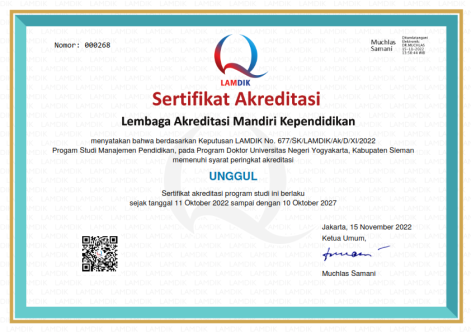
Sertifikat dapat diunduh disini.
SISTEM INFORMASI
Kontak S3 MP FIP UNY
Program Studi S3 Manajemen Pendidikan
Fakultas Ilmu Pendidikan
Universitas Negeri Yogyakarta
Jl. Colombo No.1, Yogyakarta, Daerah Istimewa Yogyakarta 55281
Website: https://s3mp.fip.uny.ac.id/
Email: s3mp@uny.ac.id
Instagram
Facebook
Youtube



Copyright © 2026,